
(The title of this in-depth article is a paraphrase of the title of a well-known book by Marcello D’Orta )
Control over data transmission networks is becoming a geopolitical and strategic issue comparable to control over sea lanes in the 19th century or energy networks in the 20th.
For over a century, undersea cables have been shared infrastructure, built and managed by consortia of telecommunications operators, governments, and specialized companies.
Today, the paradigm is shifting. Major American tech companies—particularly Google, Meta, Amazon Web Services, and, to an increasing extent, Microsoft—are building their own submarine cables, intended primarily for traffic generated by their cloud services, AI, streaming, and data centers.
- The emerging risk is the fragmentation of the Internet:
- • private infrastructure dedicated to the digital giants;
- • public or consortium-based infrastructure used by everyone else.
And further segmentation is obviously possible: for example, national networks or military networks. In such a scenario, control over the global network could shift from governments to Big Tech, creating a model that diverges significantly from the global Internet we have known until now—which is almost a “public good” like the air we breathe.
How the Internet Works… Roughly Speaking!
When it comes to Internet infrastructure, undersea cables are just the most visible part. In reality, they represent only the physical transport layer, while the network’s operation depends on a much more complex ecosystem composed of routers, switches, data centers, optical systems, exchange points, and control software.
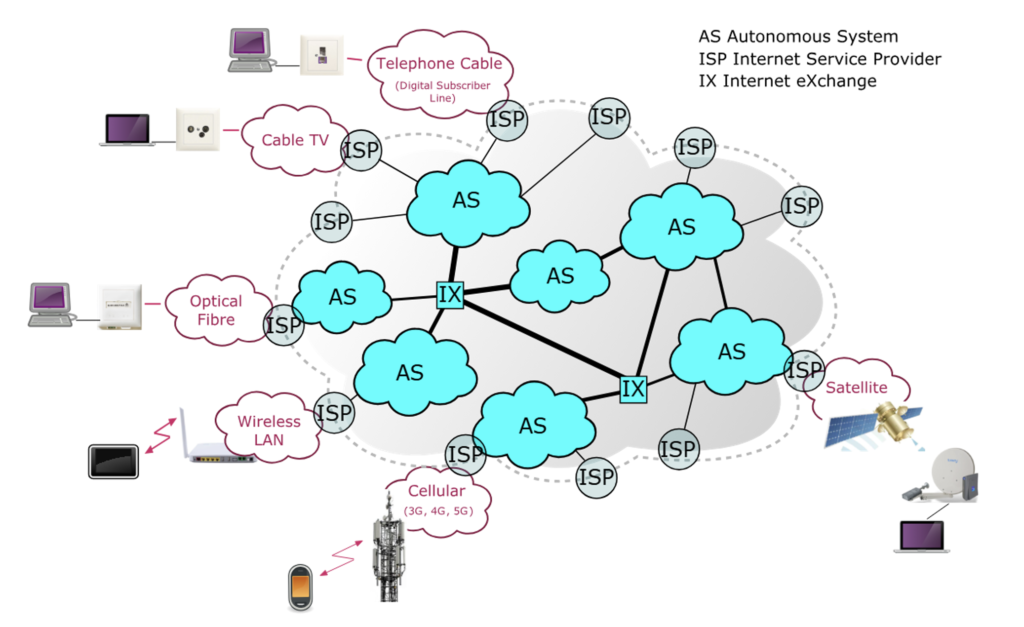
Figure 1. Schematic representation of the current Internet and its main components.
We can think of the Internet as a global nervous system. Before continuing with this anatomical metaphor and describing the individual nodes of the system, it’s worth noting that any file is a long (or very long) sequence of bits that, if uploaded to the network in its entirety—to transfer it from a sender to a recipient—would clog up the network itself. To ensure smooth flow, therefore, any file (even small ones) is divided into packets of bits. Typically, the sender “unpacks” the file, and the recipient “re-packs” it; meanwhile, all network components “route” these packets.
1. Submarine Cables
These are the “axons” that carry traffic between continents. The main routes are: Europe–U.S., U.S.–Asia, Europe–Middle East, and Africa–Europe. They carry light pulses via optical fiber. As mentioned, they carry packets of bits, not entire files.
2. Routers
Routers are the brain of the network. Every data packet sent—whether it’s part of an email, a YouTube video, a ChatGPT request, or a bank transfer—must pass through dozens of routers.
The router determines the best path to reach the recipient. It is the equivalent of air traffic control. The leading router manufacturers today are:
Routers operate within ISPs or IXs (see Figure 1).
3. Switches
Switches operate within local networks (part of the ASs in Figure 1).
If the router decides which city to send a truck to, the switch decides which building to deliver the package to. They are essential in data centers, the cloud, corporate networks, and telephone exchanges. AI is driving explosive growth in demand for ultra-high-capacity switches.
The current leaders in the manufacture of these devices are:
Hoping to have provided a sufficiently clear insight into the backbone of the internet, we ask ourselves the most fundamental of questions: who really controls the internet?
It will come as no surprise that there is no clear and definitive answer, and that it depends on the (albeit brief) history of the internet. In the 1990s, we would have answered: the telephone companies. Today, the answer is very different. A big tech company can simultaneously own: undersea cables, data centers, proprietary switches and routers, cloud services, and AI models.
Google is probably the most advanced example; Meta and Amazon are following a similar trajectory. The real strategic risk, therefore, is not a single cable but complete vertical integration—which, fortunately, hasn’t happened yet, but we’re almost there.
Satellite Internet
What about satellites? One might think that satellites are replacing (and will increasingly replace) routers and switches. In reality, the opposite is true. Modern satellite constellations are themselves gigantic networks of routers. The first generation of satellites consisted mainly of geostationary satellites, which were essentially “radio mirrors.” They received a signal and retransmitted it. Very little on-board intelligence.
With the advent of Starlink and new constellations, things have changed radically. Each Starlink satellite contains processors, routing systems, laser links, and other functions similar to those of routers. In practice, each satellite is an orbital network node. We can imagine a Starlink constellation as a gigantic flying Internet.
- To better understand the basis for our futuristic scenarios, let’s cover a couple of concepts regarding the technical operation of satellites. There are two main types of satellites:
- • Low Earth Orbit (LEO)
- • Geostationary Earth Orbit (GEO)
The main difference between LEO and GEO satellites is their orbital altitude, which determines performance, coverage, costs, and applications. Table 1 provides a summary of the main technical characteristics of the two types of satellites
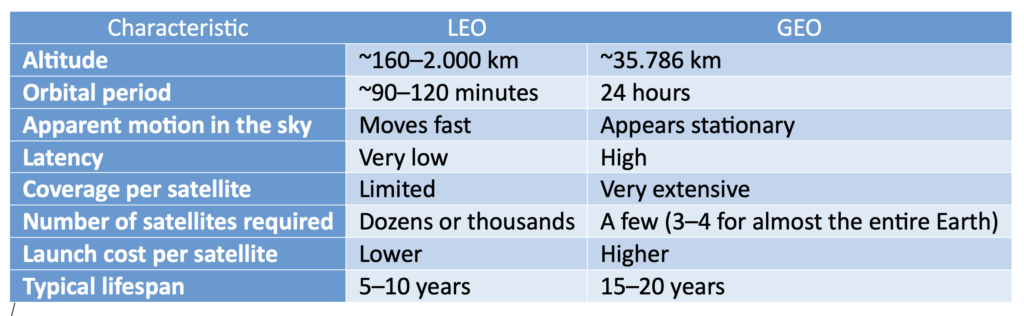
Table 1. Main technical characteristics of LEO and GEO satellites.
In Figure 2 and Figure 3, we provide a stylized image to help visually understand the difference between the two types.
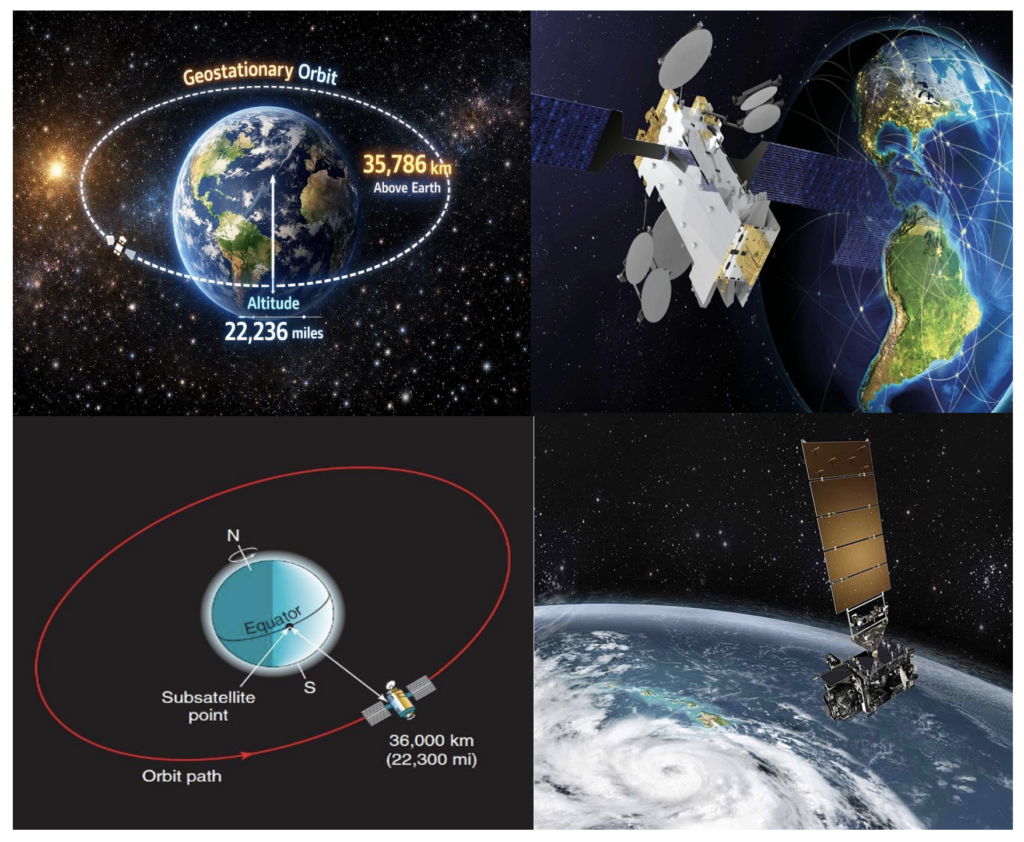
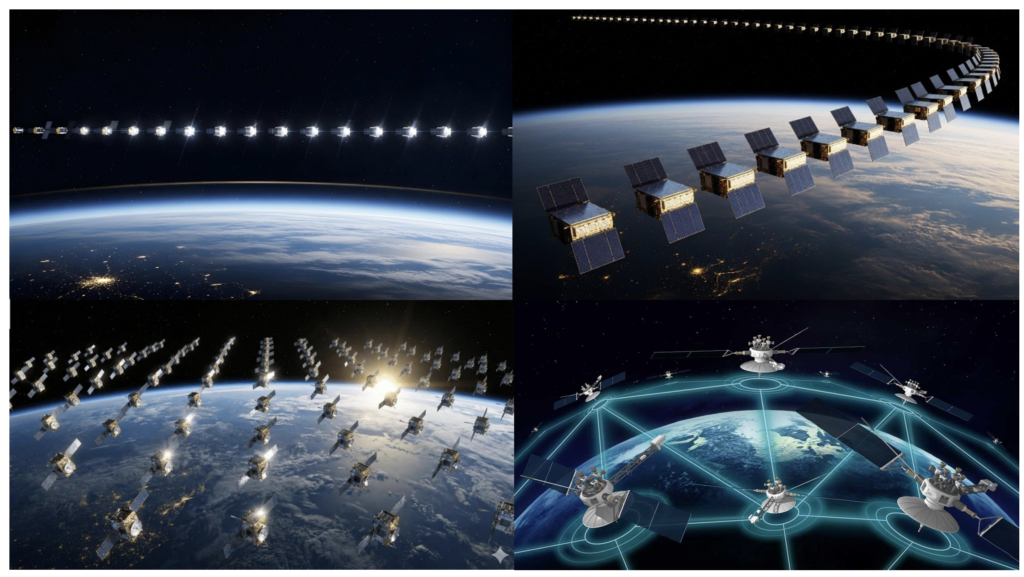
Figure 3. Images of LEO satellites.
LEO satellites orbit much closer to Earth, typically between 500 and 1,200 km. Since they move rapidly relative to the Earth’s surface, constellations with many satellites are needed to provide continuous coverage. They are currently used by SpaceX (Starlink), Eutelsat (OneWeb), and Amazon. Among the advantages they offer are very low latency (20–50 ms) and high speeds, which make them particularly well-suited for internet data transmission and real-time applications. On the other hand, ensuring good global coverage requires hundreds or thousands of satellites, which are much more complex to manage and have a shorter operational lifespan—all factors that affect costs.
We can therefore understand why Starlink uses this type of satellite: the goal is to provide internet comparable to fiber. A GEO satellite orbits at a distance of approximately 36,000 km and has a minimum physical latency of about 240 ms round-trip. With a LEO satellite, the orbital distance is reduced to 550 km and the physical latency to about 20–40 ms. This difference makes video conferencing, online gaming, electronic trading, and cloud applications possible.
It is therefore not surprising that the satellite sector is currently shifting from GEO to LEO, with GEO remaining dominant for broadcasting and certain government services, and LEO being the fastest-growing segment thanks to demand for global connectivity. The companies most exposed to the LEO trend include the three we mentioned above, while operators historically focused on GEO, such as SES and Intelsat, are seeking to integrate LEO capabilities to remain competitive.
Furthermore, without necessarily being fortune-tellers, within ten years it will likely be commonplace to have routers installed directly on satellites that will be responsible for routing data packets by choosing the optimal path from a much wider range of available options: space routers will, in fact, be able to choose between or combine at least the following three solutions: satellite-to-satellite; satellite-to-ground station; satellite-to-submarine cable. Just as terrestrial routers do today, but with a narrower range of choices, limited to selecting their “peers.”
Alongside Starlink, other players are entering this market, including Amazon, Eutelsat, Telesat, and China SatNet. These networks could become the natural complement to undersea cables.
Why are submarine cables so important today? The current transmission routes are:
- • submarine cables, through which more than 95% of international data traffic passes;
- • satellite links, which handle less than 5% of digital data traffic.
The undisputed success of cable-based data transmission is primarily due to three factors: latency, capacity, and cost (see Table 2).
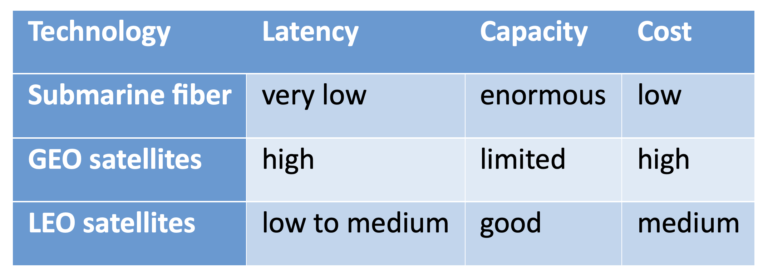
Table 2. Comparison of fiber-optic cables and satellite communications.
A single modern transatlantic cable can carry hundreds of terabits per second: this is a capacity that no satellite constellation can currently match economically.
And why will they continue to play a key role in the future? The most likely scenario over the next twenty years—if we completely rule out quantum phenomena—is not the replacement of cables but a hybrid structure developed across various levels (or layers). An example of a layered architecture capable of handling current data traffic might be:
- • Layer 1. Global backbone of submarine fiber-optic cables.
- • Layer 2. Satellite constellations for redundancy, emergency management, coverage of remote areas, and finally military and strategic use (e.g., intelligence services).
- • Layer 3. Terrestrial networks and data centers.
But this futuristic architecture could undergo changes due to data traffic that we cannot yet imagine, but which we can expect to increase sharply due to both AI and quantum computing—which will also alter the quality of the information transmitted.
The Arrival of the Quantum Internet
Here, the situation is even more interesting because the quantum internet will also require routers and switches, though they will be very different from current ones. Quantum routing is inherently complex and difficult to implement. In the traditional Internet, we can copy a packet, amplify it, and regenerate it. In the quantum world, we are prevented from doing so by the No-Cloning Theorem (see our in-depth article from May 29, 2026). A quantum state cannot be perfectly copied, and this limitation completely changes the network architecture.
Future quantum routers will need to: distribute entanglement, coordinate quantum memories, manage single photons (or any other quantum microstate), and synchronize remote nodes. They will not simply be more powerful versions of today’s routers: they will be entirely new machines, yet they will still play a central role in handling data traffic—especially since the information to be transmitted is more complex.
Switches will also continue to exist in a quantum network because they will need to route qubits, entangled states, and quantum keys. Instead of switching digital packets, they will switch quantum states.
In this scenario, one of the most likely developments is the integration of quantum networks and satellites. We consider this a likely development because China has already tested the Micius quantum satellite.
The goal is to create Quantum Satellite Relays that distribute entanglement across continents: satellites will become the equivalent of undersea cables for the quantum Internet.
Looking ahead, we can imagine that over the next twenty years, the global infrastructure could consist of four overlapping layers.
- 1.The physical layer: undersea cables, terrestrial fiber, and LEO satellites
- 2.The classic IP layer: routers, switches, and global backbones
- 3.The cloud/AI layer, characterized by hyperscalers, data centers, and AI models. And finally:
- 4. the quantum layer, populated by quantum routers, quantum repeaters, quantum switches, and quantum satellites.
The real strategic point is that whoever controls all four of these layers simultaneously will control not only data traffic but the entire cognitive infrastructure of the global digital economy. Today, no one yet owns the entire technology stack; however, companies like Google, Amazon, Microsoft, and, to an increasing extent, certain state actors such as China and the United States are already building the first elements of what could become a future “network sovereignty.”
We believe that the quantum internet will not immediately replace the traditional internet, just as we do not expect the first quantum computers to replace classical computers. A synergy will likely emerge between machines, as well as between different types of networks. From this perspective, the quantum internet will be an additional layer of communication (number 4 in the futuristic architecture we have outlined above), with the following specific characteristics:
- • Quantum key distribution (QKD), i.e., cryptographic keys distributed via quantum states, which offers the major advantage that any eavesdropping will be immediately detectable.
- • Distributed entanglement: two widely separated nodes will be able to share correlated quantum states.
- • Ultra-secure communications, particularly useful for central banks, defense, intelligence, and critical infrastructure (e.g., nuclear power plants).
Future cables could carry: traditional internet traffic, cloud traffic, and dedicated quantum content. Current global backbones could be transformed into a quantum backbone, and this is not mere fantasy, as the first projects are already under development by the European Quantum Communication Infrastructure, DARPA, and the Chinese Academy of Sciences. Based on this, we can envision at least three developments:
o Futuristic Scenario 1: The new digital Suez Canal. By 2040, there may be only a few global quantum corridors: North America–Europe; Europe–Middle East–Asia; and the Pacific. Whoever owns these corridors will control a significant portion of the global digital economy—a role analogous to that played today by sea lanes, oil pipelines, and power grids.
o Future Scenario 2: Quantum digital sovereignty. Governments might require that government data, financial transactions, and military communications travel exclusively over national quantum networks. A new form of digital protectionism could emerge.
- o Futuristic Scenario 3: Fragmentation of the Global Internet. Today, there is essentially only one Internet. Within a few decades, we could see an Internet that is:
- – American, dominated by U.S. big tech;
- – Chinese, controlled by Chinese companies and the Chinese state;
- – European, based on sovereign infrastructure (unless Europe surprises us with a genuine federalist revolution);
- – a government-run quantum Internet, separate from all the other networks listed above and managed by each individual government—a sort of advanced “splinternet.”
Let’s draw some conclusions
Beyond the futuristic scenario we’ve just outlined, a question is emerging that many governments are beginning to view as critical: if Google owns the cable, AWS owns the cloud, and Meta controls the platforms, who really controls the flow of information?
In theory, governments can impose regulations, but this does not mitigate the risk that, in practice, a handful of companies could end up managing the physical infrastructure, cloud services, AI models, and social media platforms: a concentration of power never before seen in the history of telecommunications.
What we know for certain today is that the companies actually building the cables for the big tech firms—which certainly do not lay the cables themselves—are specialized firms that make up a highly skilled industrial ecosystem within which we can identify several key players.
- n Cable manufacturers
- • Nexans
- • SubCom
- • ASN (Alcatel Submarine Networks)
- • NEC Corporation
- n Installation and maintenance
- • Global Marine Group
- • Orange Marine
- • Jan De Nul Group
- • Prysmian Group
That said, it is clear that the obvious direction is toward creating a segmentation of the internet that begins with the acquisition of ownership of its backbone.
In conclusion, to offer a highly pessimistic projection of current technological developments, we can imagine that the combination of:
- • private submarine cables,
- • mega-satellite constellations,
- • hyperscale clouds,
- • artificial intelligence,
- • quantum internet,
could lead to the emergence of true “digital infrastructure powers.”
In that world, power would not be measured solely by GDP or military strength, but by the ability to control the nodes through which data, algorithms, quantum communications, and artificial intelligence flow. Future geopolitical conflicts might be less about oil and much more about control of the planet’s information backbones.
Disclaimer
This post reflects the personal opinions of the Custodia Wealth Management staff members who authored it. It does not constitute investment advice or recommendations, nor does it constitute personalized consulting, and should not be considered an invitation to engage in transactions involving financial instruments.
