
In the burgeoning field of quantum computing, QEC stands for Quantum Error Correction, but – given the increasingly rapid and exciting developments taking place in the quantum computing industry – the anagram formed by the title is far more apt. Whilst all the major start-ups – and not just in the United States – are focusing on hardware solutions for building a fully functional quantum computer, in Italy (particularly in Milan) a hub is being established for start-ups such as Algorithmiq that aim to produce quantum software (see news). Needless to say, this is a sector we will be following with particular interest, if only because it sees Europe (and Italy) at the forefront of riding the massive waves of a truly radical innovation. However, the recent announcement by IonQ and the proliferation of thematic funds compel us to provide a comprehensive overview of the state of the art in quantum computer construction.
In 2026, quantum computing finds itself in a historically unique phase: the public narrative speaks of an industrial race, IPOs, acquisitions and market valuations, but the technical reality is far more selective. It will not necessarily be those who currently possess the greatest number of physical qubits who will win, nor those announcing the most spectacular benchmarks. The deciding factor is becoming increasingly clear: the ability to transform ‘noisy’ hardware into reliable logical qubits via Quantum Error Correction (hereafter, this will be the sole meaning of QEC). In this sense, the competition is still wide open because no architecture has yet demonstrated definitive superiority on an industrial scale, but all are converging on the same bottleneck: error control.
Why QEC is at the heart of the game
The physical qubit, by its very nature, is fragile. Interactions with the environment, electronic noise, gate imperfections and quantum decoherence introduce continuous errors. Unlike classical computing (which allows current computers to function based on transistors and different voltages to represent the bit), it is not possible to simply duplicate quantum information to create redundancy, due to the no-cloning theorem. For this reason, quantum error correction does not consist of ‘copying data’, but of distributing the information of a logical qubit across many correlated physical qubits. These concepts are very complex for non-specialists. However, we will try to summarise them in a few lines, hoping to convey at least the fundamental intuition behind the issue.
Quantum decoherence and the no-cloning theorem are two distinct yet deeply interconnected concepts, because together they explain why protecting quantum information is far more difficult than in classical computing.
Quantum information is based on two fundamental concepts: superposition and entanglement.
Superposition is the property whereby a qubit can exist simultaneously in a combination of two binary states (commonly denoted by 0 and 1), until the moment of measurement (or observation, i.e. interaction with the environment).
Unlike a classical bit, which is either 0 or 1, a qubit in superposition contains both possibilities coherently, and this confers upon them certain intrinsically fundamental characteristics listed in Table 1.

Entanglement is a physical correlation between two or more qubits such that their state cannot be described separately, but only as a single shared system.
In practice, measuring one entangled qubit instantly determines the correlated outcome of the other, regardless of the physical distance between the two qubits.
Entanglement is a fundamental resource because it enables the applications listed in Table 2.

In essence, entanglement is the non-classical link that makes quantum systems more powerful than traditional systems.
Decoherence is the process by which a qubit loses its phase coherence and the properties of quantum superposition and entanglement due to unwanted interaction with the environment. In practice, the system ‘leaks information’ to the outside and the quantum state progressively degrades, becoming increasingly similar to a classical state.
The no-cloning theorem, on the other hand, states that it is not possible to create a perfect copy of an arbitrary and unknown quantum state.
In the classical world, if a bit is fragile or noisy, it is sufficient to copy it many times and use redundancy (backups, majority-voting algorithms, RAID, memory replication). In the quantum world, this approach does not work because decoherence destroys quantum information and – at the same time – the no-cloning theorem prevents the creation of perfect backups. It is this dual challenge that makes QEC necessary.
Since a quantum state cannot be cloned, protection is achieved not by copying the qubit, but by encoding the information in a distributed manner across many entangled physical qubits.

For example, in stabiliser or surface codes, the content of the logical qubit is never read directly: auxiliary operators are measured that reveal only where the error occurred, not what the information contained was (because it is impossible to know this due to quantum decoherence).
Decoherence can be interpreted as a sort of ‘involuntary measurement’ carried out by the environment. When the qubit ‘couples/entangles’ with the external environment, part of the phase information is lost to the environment and can no longer be recovered locally. The no-cloning theorem prevents us from having perfect copies within the system.
Decoherence explains why qubits become corrupted; the no-cloning theorem explains why we cannot save them by copying them. From this combination arises the entire modern architecture of quantum error correction and, ultimately, the central challenge of scalable quantum computing.
A QEC code typically operates in three phases. In the first phase, the logical state is encoded in a register of physical qubits. In the second, some auxiliary qubits measure parity operators (stabiliser checks) without collapsing the useful computational state. In practice, they do not read the data, as this would result in information loss, but continuously detect whether the data is becoming corrupted and emit an error signal (or syndrome). In the third stage, a classical decoder interprets the ‘error syndromes’ and determines the most probable correction. This process must occur cyclically and with minimal latency; otherwise, errors accumulate faster than they can be corrected.
The decisive concept is that of the threshold theorem: below a certain physical error threshold, increasing redundancy exponentially improves the reliability of the logical qubit; above that threshold, redundancy worsens the situation because it introduces more errors than it corrects (see Table 4). Consequently, metrics such as the fidelity of two-qubit gates have direct economic and strategic value.
The technical significance of IonQ’s 4 nines
IonQ’s announcement regarding the achievement of 99.99% fidelity on two-qubit gates (fidelity gates) must be understood precisely within this context. Entangled two-qubit gates are the most critical component of the error budget in circuits. Moving from error thresholds of 1% to 0.01% means reducing the probability of failure for each computational operation by approximately two orders of magnitude. This does not automatically imply complete error tolerance, but it drastically reduces the computational load required by QEC codes.
To understand the impact, consider the following qualitative relationship:

IonQ, based on trapped ion technology, has historically benefited from long coherence times and high connectivity between qubits. This makes the architecture particularly well-suited to high-precision operations, although it is often penalised in terms of clock speed compared to superconducting-based systems.
The main competing architectures
The market is not converging towards a single technology. On the contrary, capital continues to be spread across different approaches: superconducting qubits, trapped ions, neutral atoms, photonics, silicon spin qubits and even more speculative avenues (see Table 5). This is a strong signal: professional investors believe that the winner cannot yet be identified.
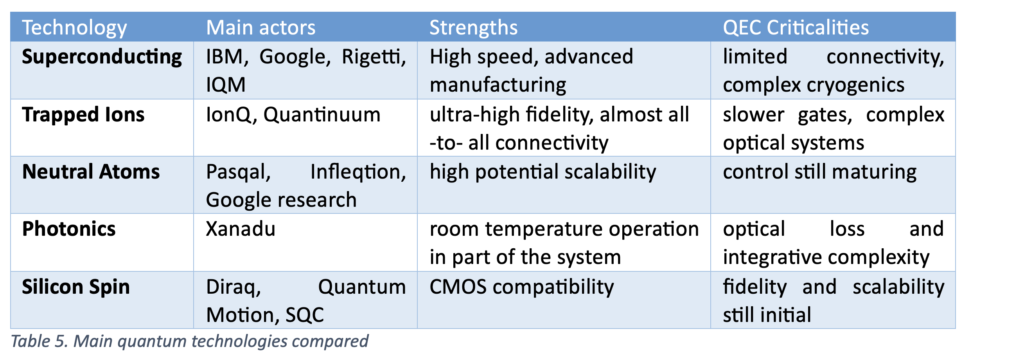
Below, we will analyse the two technologies based on neutral atoms and photons of light. So here we will say a few words about silicon spin. This is a quantum architecture in which qubits are created using the spin of electrons confined within nanometre-scale silicon structures.
The idea is to exploit a fundamental quantum property of the electron — spin — which can take on two principal states representing the classical 0 and 1. Spin is a fundamental quantum property of the electron that behaves like a kind of intrinsic angular momentum. It is important to clarify one thing straight away: the electron is not actually ‘spinning on its own axis’ like a ball. The term ‘spin’ is historical, but in quantum mechanics it represents an intrinsic property of the particle, analogous to mass, electric charge and magnetic moment. Put bluntly and without any claim to scientific rigour, a ‘spinning’ electron behaves like a tiny magnet; therefore, by applying a magnetic field, the spins of different electrons can be aligned, their energy altered, but above all they can be manipulated and measured—and this, for a particle possessing only two states, becomes fundamental for computational purposes.
In quantum computing, the qubit is precisely the spin state of an electron whose rotation is controlled by electromagnetic pulses. Entanglement arises by pairing neighbouring spins.
IonQ vs Quantinuum: precision versus integration
Among the leading players in the trapped-ion approach, IonQ and Quantinuum represent two distinct industrial models. IonQ has opted for the public market, focusing on branding, capital raising and visibility. Quantinuum, born from the merger of Honeywell Quantum Solutions and Cambridge Quantum, appears instead to be more vertically integrated: hardware, software stack, cybersecurity and established enterprise relationships.
From a QEC perspective, both have a favourable foundation: accurate gates and extensive connectivity reduce the complexity of many error correction codes compared to strictly local layouts. However, the ultimate advantage will depend on the ability to orchestrate millions of syndrome extraction cycles with stable performance, not just on isolated benchmarks.
IBM and Google: the strength of engineering scale
IBM and Google continue to focus primarily on superconducting qubits. This approach generally suffers from inferior gates (in terms of errors) compared to the best trapped-ion systems, but offers enormous advantages in operational speed, industrial integration, software toolchains and production capacity. Even Google has launched parallel programmes on neutral atoms, a sign that even the leaders do not consider the technological race to be over.
In the long term, the real advantage of IBM and Google could lie in their ability to industrialise QEC on a vast scale: cryogenics, packaging, control electronics, compiler stacks and supply chains.
D-Wave and Rigetti: two special cases
D-Wave follows a different path, historically centred on solving complex optimisation problems (known as quantum annealing, which addresses problems that even today’s supercomputers cannot solve with precision). Although not the most sought-after universal paradigm, it has more immediate use cases in logistics and scheduling. Rigetti, on the other hand, remains a bet on independent superconducting technology: high theoretical upside, but direct competition with heavily capitalised giants.
The role of capital: why the race is still wide open
The key point for this sector is that money continues to fund multiple approaches simultaneously. In mature sectors, capital converges on the likely winners; here, the opposite is happening. This means the market still perceives a pre-dominant phase, similar to the early years of aviation or semiconductors.
Furthermore, recent acquisitions show a trend towards vertical integration: IonQ has acquired Oxford Ionics, whilst D-Wave has acquired Quantum Circuits. This suggests that no player considers native hardware alone to be sufficient; IP, talent and complementary components are needed.
The real metric to watch in the coming years
The market often continues to talk about the number of qubits. From a scientific point of view, this is an incomplete metric. The most useful order of priority is instead shown in the following table:
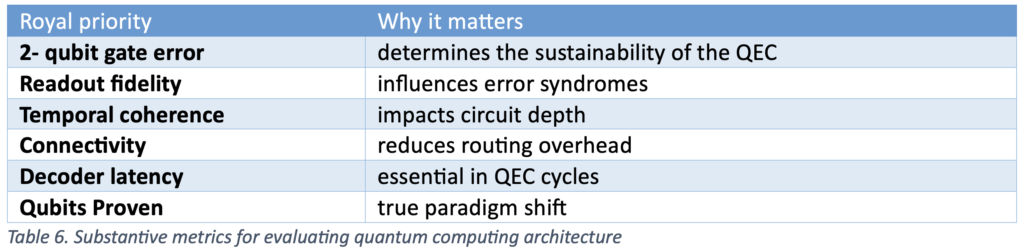
When the sector moves from ‘1,000 physical qubits’ to ‘10 useful logical qubits’, the industrial evaluation framework will change completely.
Integration: the new international contenders keeping the quantum race open
Competition is no longer limited to the US–Big Tech–listed first movers triangle. Capital is flowing towards a second wave of companies representing alternative architectures and a much broader geography of quantum innovation. In particular, Infleqtion (USA), Xanadu (Canada), Pasqal (France) and IQM (Finland) are cited as examples of players that could materially influence the market in the coming years.
This is significant because it suggests that the sector has not yet reached technological convergence. If investors were convinced that trapped-ion or superconducting qubits had already won the race, capital would be concentrated solely on IonQ, Quantinuum, IBM or Google. Instead, the opposite is happening.
Infleqtion (USA): neutral atoms and quantum sensing
Infleqtion, formerly known as ColdQuanta, is one of the most interesting names in the US ecosystem. The company is working on platforms based on neutral atoms, a technology that uses neutral atoms trapped and manipulated by lasers. Neutral atoms are atoms that have an equal number of protons and electrons; therefore, unlike trapped ions, they have a total electric charge of zero. This approach aims to combine high geometric scalability with good qubit quality.
From a QEC perspective, neutral atoms are promising because they allow for very dense two-dimensional and three-dimensional arrays, which are useful for topological codes such as surface codes or adapted LDPC codes. Therefore, the spatial (geometric) organisation of the qubits is of fundamental importance. In fact, many modern QEC codes — especially surface codes — do not work on isolated qubits, but on networks of qubits that must interact locally with their neighbours.
For example, in a surface code, each qubit must continuously perform stabiliser checks with the surrounding qubits. This structure requires many physical qubits, ordered connectivity, a regular two-dimensional arrangement, and controlled interactions between neighbours.
In neutral atom systems, atoms are trapped using lasers (‘optical tweezers’) and can be positioned almost like points on a programmable grid.
This offers three major advantages:
- 1) very dense arrays, i.e. more qubits in less space
- 2) reconfigurable geometry that allows for code optimisation
- 3) controllable interactions and therefore more efficient stabiliser checks
Unlike superconducting qubits, where the chip geometry is physically fixed, in neutral atoms the arrays can be dynamically rearranged.
The surface code is currently one of the most promising QEC codes because it tolerates relatively high error rates, uses only local interactions and scales well (at least in theory). However, it requires enormous 2D networks of qubits.
The good news is that neutral atom systems are particularly promising for addressing this challenge because they allow us to:
- • construct regular 2D lattices in a relatively straightforward manner;
- • achieve hundreds or thousands of atoms in compact configurations;
- • connect them in a more flexible way.
And the advantages do not end there, because neutral atoms enable significant advances in the creation of quantum LDPC (Low-Density Parity-Check) codes—that is, a new generation of QEC codes aimed at drastically reducing the required redundancy—but they require more sophisticated connections, non-trivial interaction networks and high topological flexibility – goals more easily achievable through spatial reconfigurations, selective interactions and quasi-three-dimensional architectures, all characteristics unique to neutral atoms.
Furthermore, Infleqtion is not just about quantum computing: it also operates in quantum sensing and timing, a strategic element because it generates applications closer to the market than error-resilient computing alone.

Xanadu (Canada): the photonic gamble
Xanadu represents one of the most original platforms on the global scene: photonic quantum computing. Instead of using atoms or superconducting circuits, it utilises photons as carriers of quantum information.
The main theoretical advantage is significant: photons interact very little with the environment, so they are less susceptible to certain decoherence mechanisms. Furthermore, they can travel naturally along optical fibres, making the platform potentially ideal for quantum networking and distributed quantum computing.
However, photonic QEC is highly complex. As photons interact very little with one another, realising deterministic gates and efficient error-correction schemes requires sophisticated architectures, cluster states and very substantial optical resources.

Pasqal (France): the European leader in neutral atoms
Pasqal is probably the best-known European name in the neutral atom sector. Its technological model is similar to Infleqtion’s, but with strong French scientific backing and ambitions for continental leadership.
Pasqal’s platform is particularly interesting for quantum simulation, optimisation and many-body problems, where the flexible arrangement of atoms can become an architectural advantage. Many-body problems are physical problems in which a system contains many quantum particles that interact simultaneously with one another in various ways, such as electromagnetic interactions, quantum correlations, entanglement and collective effects.
Solving many-body problems is particularly important for the study of new materials and molecules.
The crux of the matter is that the overall behaviour cannot be described simply by analysing one particle at a time, because interactions and entanglement create extremely complex collective properties, too complex to allow for efficient simulations using classical computers. More technically, if there are N particles, the number of states to be analysed grows according to the following law: 2N. That is, exponentially.
From a QEC perspective, the crux lies in the transition from promising NISQ-type systems to true fault-tolerant machines. If Pascal manages to improve gate fidelity whilst maintaining high density, it could become one of the most formidable competitors for its rivals.

A NISQ (‘Noisy Intermediate-Scale Quantum’) system is a quantum computing platform large enough to perform interesting experiments, but still too prone to noise to sustain long, reliable calculations.
In practice, the qubits work and entanglement can be created, allowing limited algorithms to be run; however, errors accumulate too quickly.
Therefore, the system cannot yet support full-scale QEC.
A fault-tolerant machine, on the other hand, is different. It is not enough to have many qubits, good benchmarks and demonstration circuits. It is necessary to be able to continuously detect errors, correct them in real time and maintain a logical qubit in a stable state for long periods. Unfortunately, this requires very accurate gates and precise readout of their state, systemic stability and manageable redundancy.
And this is where the issue of gate fidelity comes in.
IQM (Finland): European superconducting with industrial DNA
IQM is one of the most established European players in the superconducting qubit paradigm, currently the most widely adopted by major groups such as IBM and Google.
This is significant because, through IQM, Europe is not only competing in the field of neutral atoms or software (meaning quantum algorithms), but also has a player in the most industrially mature segment. Superconducting technology offers very fast gate times and an already advanced ecosystem of electronic control and cryogenics.
For the QEC, IQM inherits both the advantages and limitations of the platform: high speed and mature toolchains, but with severe constraints regarding local connectivity and cryogenic requirements. By ‘toolchain’ we mean the technological ecosystem surrounding superconducting qubits, which is already relatively advanced and industrialised compared to other quantum architectures.
We are not just talking about the hardware, but the entire set of tools needed to design, programme, control, calibrate and operate a real quantum computer. In particular, a quantum toolchain comprises the following components:
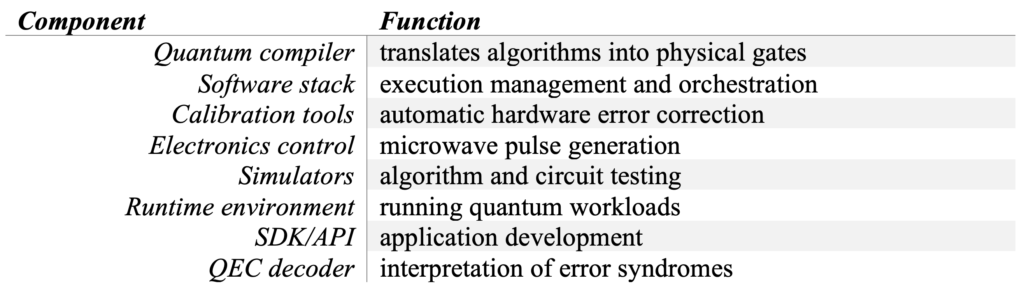
In the case of superconducting qubits (such as IBM, Google, Rigetti Computing and IQM), this infrastructure has existed for years and is highly developed.

Competitive impact relative to IonQ, Quantinuum, IBM and Google
The existence of these four players demonstrates that the market does not believe the outcome is a foregone conclusion. Each occupies a strategic niche:
This means that IonQ and Quantinuum are not merely competing with one another; IBM and Google do not compete solely internally; there is a second level of challenges that could emerge through technical advances, government partnerships or acquisitions.
From the QEC’s perspective, these companies matter because they bring different architectures, and the winner of the decade could simply be the platform that minimises the cost per correct logical qubit. Not necessarily the one with the most physical qubits, nor the one with the best marketing benchmark.
Infleqtion, Xanadu, Pasqal and IQM are not minor players: they represent concrete proof that the sector is still in an advanced exploratory phase. If IonQ embodies trapped-ion precision and IBM the scale of superconductors, these new players embody the most important principle of 2026: the quantum race remains open because no one has yet demonstrated the economic supremacy of their QEC model at scale.
Conclusion
In 2026, the quantum race remains wide open, despite significant technical challenges. IonQ’s announcement of 99.99% accuracy confirms that trapped ions remain among the most elegant platforms in terms of precision. Quantinuum appears very strong in enterprise integration. IBM and Google maintain their engineering leadership at scale. New players in neutral atoms, photons and silicon spin continue to attract capital because the winner is not yet known. However, beneath all the market narrative, there remains only one dominant variable: whoever can implement efficient, stable and scalable Quantum Error Correction will be the true leader of the quantum decade.
Disclaimer
This post reflects the personal opinions of the Custodia Wealth Management staff who authored it. It does not constitute investment advice or recommendations, nor does it constitute personalised advice, and should not be regarded as an invitation to trade in financial instruments.
