

This week, the Financial Times published two articles we’d like to highlight, and we’ve provided a brief summary of each.
Switzerland – UBS
The Financial Times describes UBS’s political victory in the battle over the new capital requirements. The Swiss Parliament is considering softening the government’s proposal, allowing UBS to meet up to half of the new requirements with AT1 instruments rather than CET1 capital. The issue reflects the difficult balance between the need to reduce systemic risk following the Credit Suisse bailout and the need to avoid undermining the international competitiveness of UBS and the Swiss financial center. (Financial Times)
Japan – “The Takaichi Revolution”
The British business daily analyzes the political and economic transformation initiated by Prime Minister Sanae Takaichi: increased public spending, industrial policy, and defense buildup aim to revive an economy that has long been stagnant. The problem is that this strategy creates tension with the bond market: JGB yields have risen significantly, while the BoJ is gradually normalizing monetary policy. The real test for Takaichi will therefore be whether she can sustain growth without losing control of inflation and, above all, the sustainability of public debt. (Financial Times)
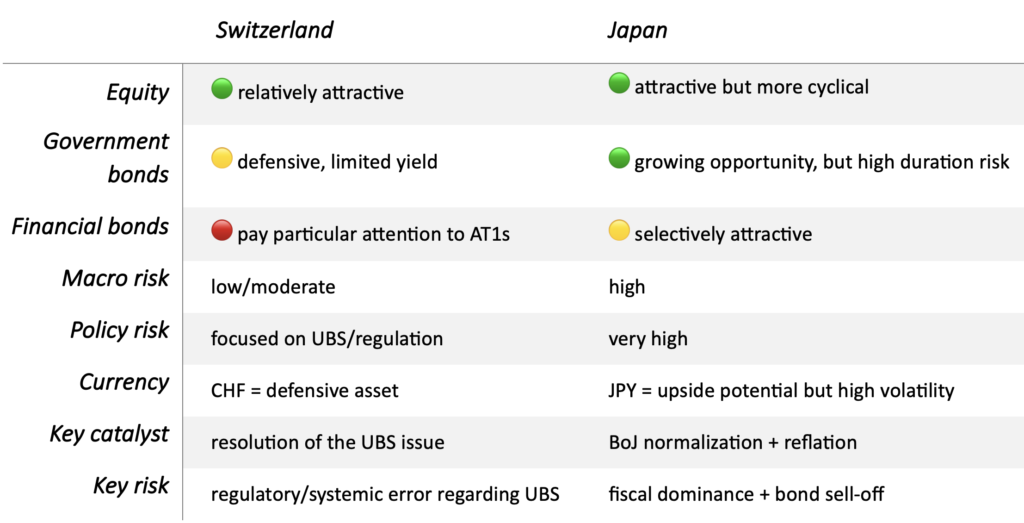
On the surface, these two stories seem to have nothing in common. They involve two countries at the center of two seemingly unrelated issues—the parliamentary negotiations over UBS’s capital requirements and the breach of the 3% threshold on Japan’s 10-year yield—but when viewed from an investor’s perspective, they share the same fundamental question: how much risk can a system absorb before government intervention becomes necessary? In Switzerland, the risk is concentrated in the balance sheet of a single systemic bank; in Japan, it lies in the sovereign balance sheet and the government bond market. This is the difference between the “too big to fail” problem and the “too much debt to ignore” problem.
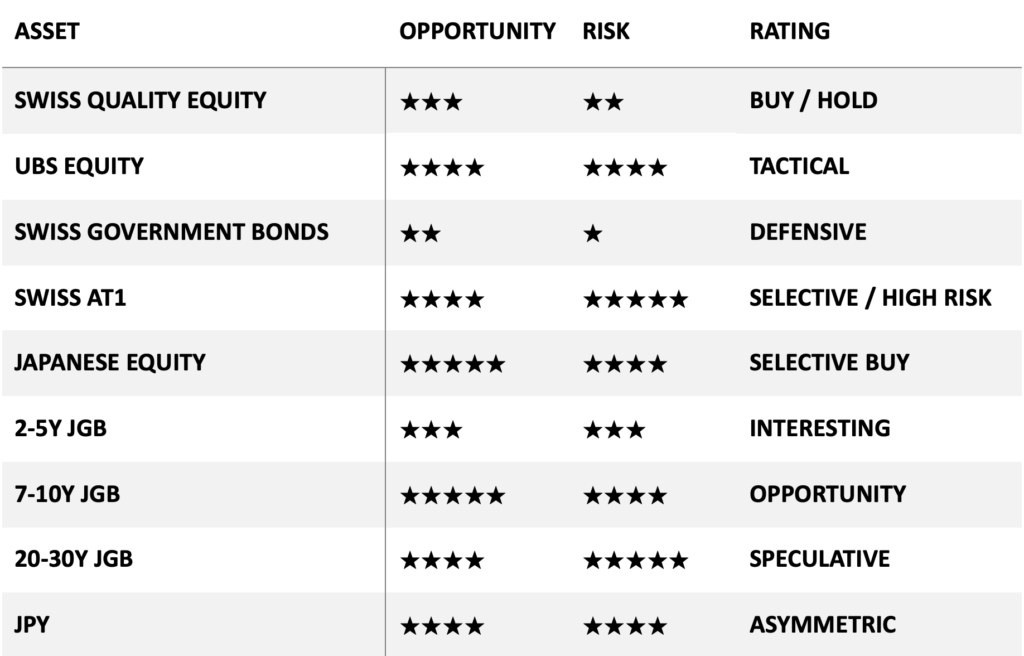
We summarize our view in the following two tables:
We invite interested parties to download the report, which contains a more in-depth analysis leading to the conclusions briefly outlined here.
Disclaimer
This post reflects the personal opinions of the Custodia Wealth Management staff who authored it. It does not constitute investment advice or recommendations, nor does it constitute personalized advice, and should not be considered an invitation to engage in transactions involving financial instruments.
