
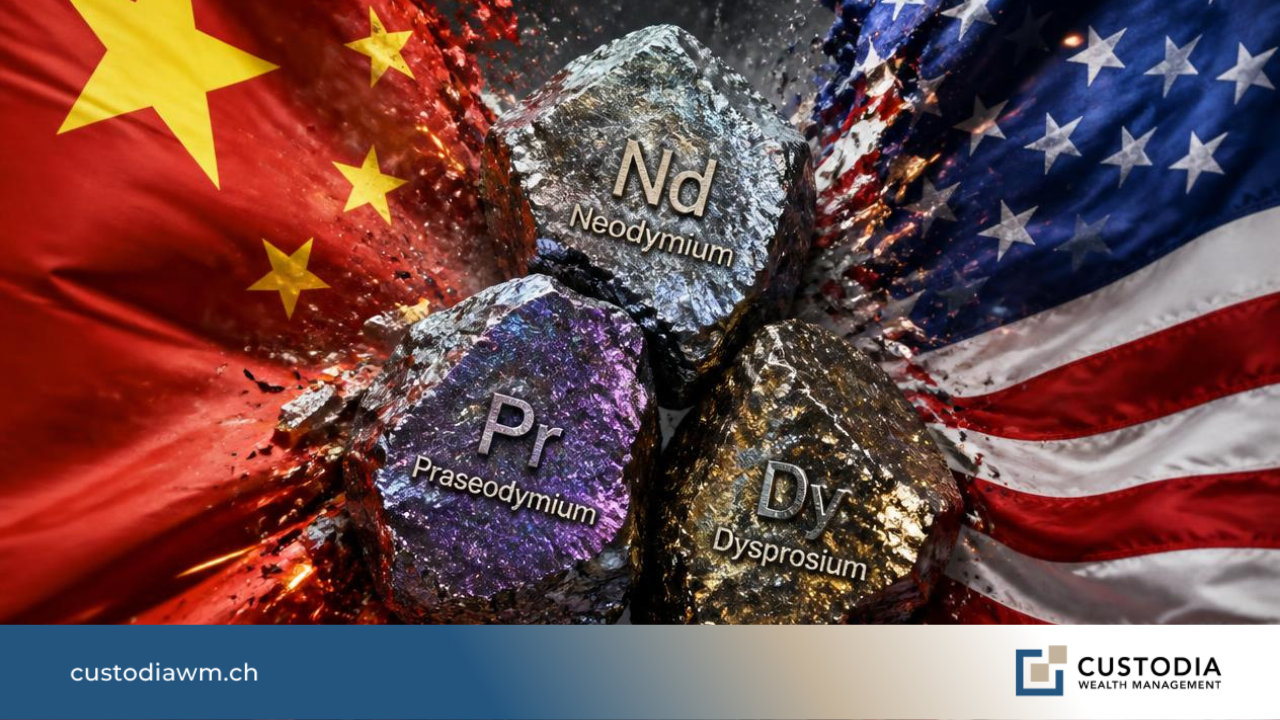
Rare earths and, more broadly, critical minerals have become one of the central issues in 21st-century economic and geopolitical competition, as well as a now widely recognized investment opportunity. Their growing importance stems not so much from their geological rarity as from the essential role they play in the development of key emerging technologies. Electric vehicles, wind turbines, artificial intelligence, data centers, robotics, aerospace, semiconductors, and defense systems all depend on materials that, until just a few years ago, were considered marginal compared to major traditional commodities.
In recent years, public debate has often portrayed rare earths as “the new oil,” fueling the idea that they automatically represent an extraordinary investment opportunity. While this interpretation captures some real aspects of the phenomenon, it is overly simplified. We have prepared a report whose primary purpose was precisely to move beyond this view by analyzing the sector from economic, industrial, and financial perspectives.
In fact, we believe there is a need to clearly distinguish between rare earths and critical minerals. The former constitute a family of seventeen chemical elements belonging to the lanthanides, plus scandium and yttrium. The latter, on the other hand, represent a much broader set of raw materials considered strategic by the world’s major economies based on their industrial importance and supply risk. Materials such as gallium, germanium, graphite, lithium, tungsten, and antimony do not belong to the rare earths category, but they are now of at least equal strategic importance.
For several months now, geopolitical factors have also dominated the financial landscape, and the rare earths and strategic minerals sector is certainly not immune to this context. China’s dominance over these materials is not attributable solely to the availability of mineral resources. Over the past thirty years, Beijing has built an integrated industrial ecosystem that encompasses mining, refining, metal production, the manufacture of permanent magnets, and the development of end-use industries. This approach has enabled the country to gain a competitive advantage that goes far beyond mere control of mineral deposits.
Contrary to popular belief, the economic value does not lie in the mine itself, but rather in the subsequent stages of the supply chain. The refining of rare earths, the production of special alloys, the manufacture of permanent magnets, and the production of technological components represent the activities characterized by the highest technological content, the highest barriers to entry, and the most attractive profit margins. This aspect also profoundly changes the way the sector should be evaluated by investors.
It is natural to wonder how the so-called “West” is responding to this Chinese dominance. The United States, the European Union, Japan, Australia, and Canada are investing substantial resources to develop new mines, refining facilities, and recycling capacity, with the aim of reducing dependence on China and increasing the resilience of their supply chains. However, it is unlikely that this process will displace China’s dominance in the short term. A more realistic scenario appears to be one characterized by a gradual geographic diversification of production and the emergence of integrated regional supply chains.
From a financial perspective, “investing in rare earths” is a broad generalization that can lead to misjudgments. In fact, each element has its own market, different growth prospects, varying levels of substitutability, and specific industrial applications. Similarly, companies along the supply chain also have profoundly different business models: a mining company, a refining firm, and a manufacturer of permanent magnets are exposed to completely different risks and opportunities.
An analysis of investment opportunities suggests that the most promising segments do not necessarily coincide with mining activities. The most attractive prospects appear to lie with companies capable of operating in stages of the supply chain characterized by high technological content, significant barriers to entry, and strong vertical integration. The growth in demand for critical materials is certainly a favorable factor, but it does not automatically guarantee high returns. The quality of the business model, the competitive position along the value chain, and the financial strength of the companies remain key determinants of an investment’s success.
The sector is exposed to numerous risk factors. Among the main ones are the volatility of commodity prices, technological developments, the potential development of substitute materials, governments’ industrial policy decisions, and geopolitical tensions. For this reason, an investment in critical materials requires a selective approach and a thorough assessment of the entire industrial supply chain, rather than simply gaining exposure to mining companies.
Overall, we can conclude that rare earths and critical minerals are neither a passing fad nor an inevitably profitable investment. Rather, they constitute a set of strategic supply chains destined to play an increasingly important role in the global economy. The most interesting opportunities will likely emerge among companies capable of transforming a raw material into a high-tech product, rather than those that limit themselves to mining activities. Ultimately, the real competition is not just about control of natural resources, but about the ability to develop industrial expertise, refining technologies, and advanced manufacturing capabilities. It is along this value chain that the key competitive advantages of the coming decade will be concentrated—and, with them, the most attractive investment opportunities.
Disclaimer
This post reflects the personal opinions of the Custodia Wealth Management staff members who authored it. It does not constitute investment advice or recommendations, nor does it constitute personalized advice, and should not be considered an invitation to engage in transactions involving financial instruments.
