
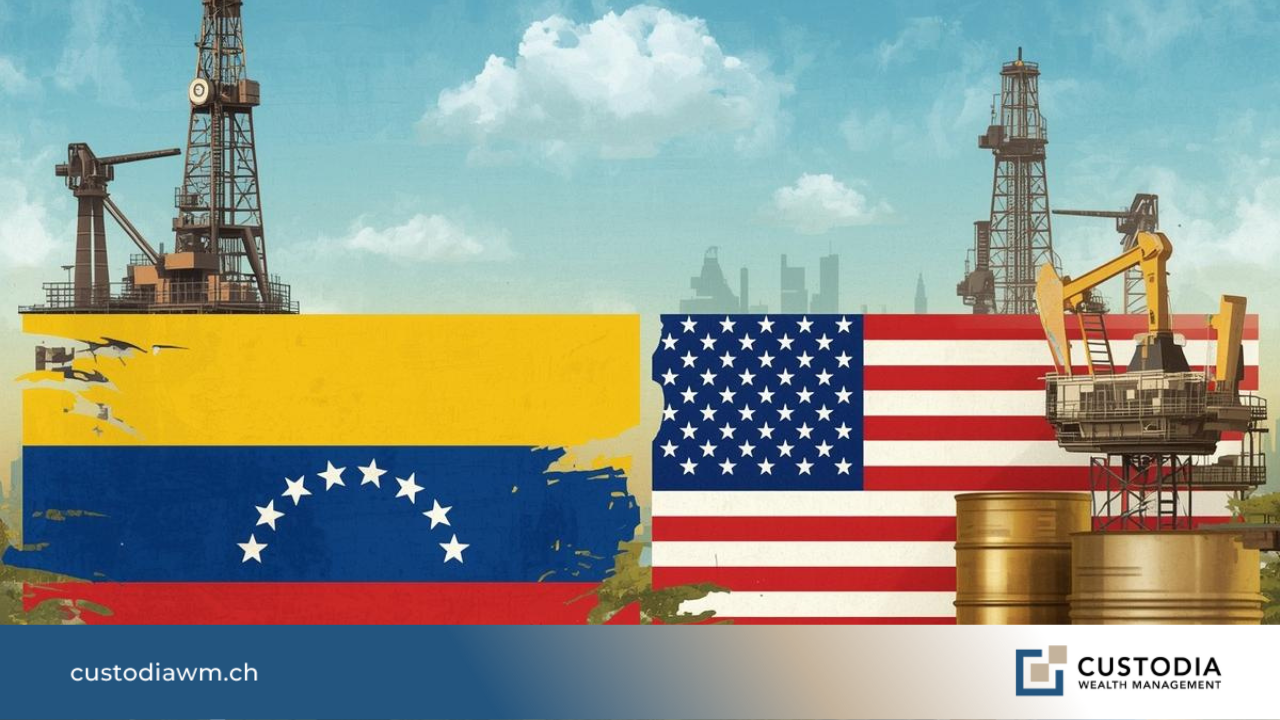
While Trump flexed his muscles on global crude oil markets, taking control of Venezuela’s oil sector and ordering US special forces to capture a Russian tanker in the North Atlantic, US officials held crucial talks with top energy executives in Miami on Wednesday, who warned the White House that they would need guarantees to invest in Venezuela. In return, the US presidency expects Chevron and ConocoPhillips to pour billions of dollars into Venezuela’s battered energy industry.
There is no doubt that the attacks in Iran and Nigeria orchestrated and perpetuated by the United States are part of a strategy to control crude oil.
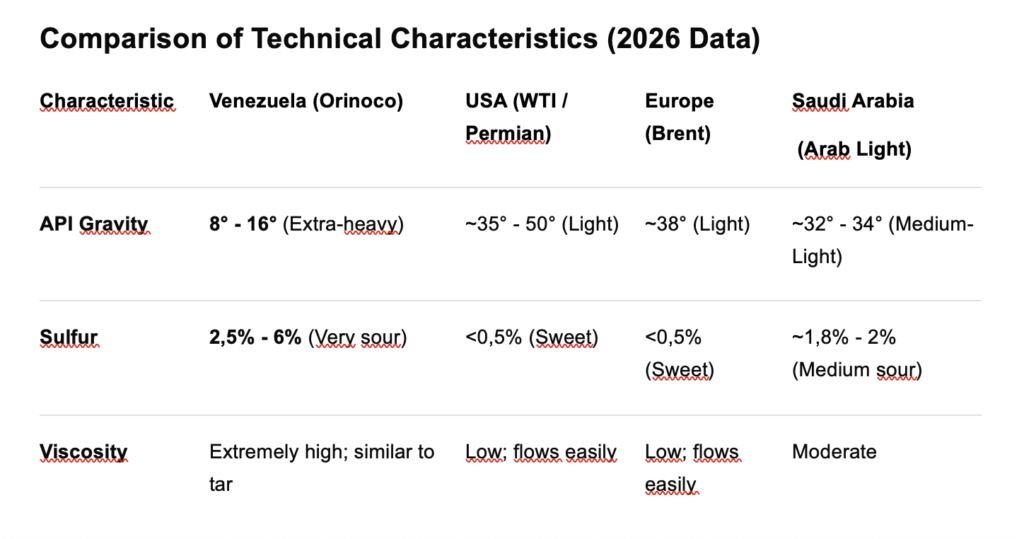
Venezuelan oil differs significantly from that of major global producers (such as Saudi Arabia or the US) in that it is predominantly extra-heavy and sour.
Although Venezuela has the largest reserves in the world (over 303 billion barrels in January 2026), the quality of its crude oil presents unique technical and economic challenges. Below is a table summarizing the main characteristics of Venezuelan oil, followed by an attempt to interpret them without dwelling too much on the chemical characteristics.
Quality Analysis Compared to Other Countries
• Extraction and Transportation Difficulties: Unlike Saudi or American oil, which flows naturally, crude oil from the Orinoco Belt is so dense that it often requires heating or the addition of chemical diluents to be transported via pipeline.
• Environmental Impact and “Dirty Oil”: Venezuelan oil was classified in January 2026 as one of the “dirtiest” in the world due to the high carbon intensity required for its refining and frequent methane leaks during production.
• Refining Costs: Being rich in metals (such as vanadium and nickel) and sulfur, it is highly corrosive to infrastructure. It requires specialized refineries with coking and hydro-treatment units, which are mainly located in the US Gulf of Mexico.
• Barrel Yield: While light oil (WTI/Brent) naturally produces large quantities of gasoline and diesel, Venezuelan crude leaves heavy residues that must be “broken down” through complex processes to obtain valuable products.
Market Positioning
Due to its low quality, Venezuelan crude oil (such as the Merey blend, a mixture of sixteen different types of oil that the state oil company Petróleos de Venezuela S.A. – PDVSA – allocates to the Asian market) is traded at steep discounts compared to international benchmarks such as Brent or WTI. It is technically comparable to bitumen from Canada’s oil sands, but much ‘heavier’ than most oil produced in the Middle East.
We imagine that this is also why the major US producers are asking the US administration to provide solid guarantees for major investments. On the one hand, we have a country that has no clear laws or reliable administration, which essentially means that tomorrow they could even confiscate profits. Furthermore, there must be solid financial guarantees because everyone is aware that, given the characteristics of Venezuelan oil and the state of the country’s oil infrastructure, the next three years will be characterized by heavy investment with returns that will materialize after many years, when, to be clear, there will be a different president.
This is yet another example of an initiative by the US presidency where it is difficult to understand where it is going.
Disclaimer
This post expresses the personal opinion of the Custodia Wealth Management staff who wrote it. It is not investment advice or personalized advice and should not be considered an invitation to carry out transactions on financial instruments.
