
In our analysis of 27 June 2025, we discussed large nuclear power plants (NPPs) and promised to explore the topic of Small Modular Reactors (SMRs) and micro-reactors in particular. That is exactly what we intend to do below, examining some of the most promising and advanced projects currently underway.
To begin with, we need to introduce some technical concepts that will allow us to better understand each project and appreciate the advantages and benefits of micro-reactors. We know that the classification criterion par excellence is the amount of energy produced in a year: SMRs are reactors with a power output of up to 300 MWe per year, while micro-reactors, which are a sub-category, reach a maximum of 20 MWe. And here we come across the first technical definition: MWe, or megawatts of electricity, measure the electricity production capacity (in MW, of course) of a plant and should not be confused with megawatts of thermal energy (MWt), which measure the thermal energy (also measured in MW) to be fed into an electricity production plant; To simplify, the former measures output, the latter input.
Another technical feature of fundamental importance is the technology used to produce electricity (or heat). Micro-reactors essentially use two in their variants or integrations: the Brayton cycle and the Rankine cycle.
The Brayton cycle is a thermodynamic cycle used to convert heat into mechanical work that can be used to drive a turbine or other devices that use thermal energy to produce useful work such as electricity.
The Rankine cycle is a thermal cycle used to generate high-pressure water vapor from low-temperature water. It can be run in open or closed circuits, with the former being more common for industrial applications. In this process, the heat transfer fluid (HTF), for example water, is heated by burning fuel to produce high-pressure steam and then cooled by expansion in a condenser. When the Rankine cycle is performed in an open circuit, a condenser is required, otherwise the pressure would be so high that the system would implode under its own weight.
The main difference between the Brayton cycle and the Rankine cycle is that the former operates entirely with gases that are fed into it, while the latter uses a liquid (or steam directly) as one of its working fluids. In the Brayton cycle, air is compressed, heated by a fuel burner, and then expanded through a turbine to produce mechanical work that powers the compressor, while in the Rankine cycle, water is heated to form steam, which expands through a turbine to produce mechanical work that powers an electric generator.

Table 1. Differences between the Brayton and Rankine cycles.
The conversion of power from micro-reactors into electricity is based in most designs on the Brayton cycle, which uses an intermediate heat exchanger. It should be noted that in some micro-reactor designs, heat is transported from the core to the intermediate heat exchanger via pipes, which marks a significant difference from current NPPs.
Both technologies obviously present the problem of cooling. The choice of coolant is crucial because it influences heat removal, which, if not properly controlled, is a critical factor. The main characteristics of a coolant should be:
• high volumetric heat capacity,
• no phase changes under normal and accidental conditions (unless boiling water is desired for a direct Rankine cycle),
• low neutron absorption,
• possibly low pressure at operating temperatures,
• limited activation in the presence of neutrons,
• chemical compatibility with core and structural materials,
• good thermal conductivity.
The coolants best suited to capturing these characteristics are molten salts, sodium, and lead-based coolants.
Molten salts have the advantages of natural convection cooling, to achieve a high temperature difference in the core regions, and high volumetric heat capacities. However, susceptibility to corrosion and high melting point are the main problems.
The advantages of sodium are the high level of existing technical knowledge, low melting point, the possibility of achieving a high temperature difference in the core regions, and the possibility of using electromagnetic pumps or natural circulation cooling to reduce the volume in the reactor. However, the complications presented by sodium are the limited possibility of regulating the flow rate to improve natural circulation and its chemical reactivity with water and air.
The advantages of lead-based coolants are natural convection cooling, the possibility of increasing flow areas, high thermal inertia due to the high boiling point, and high volumetric heat capacity. The disadvantages include the high melting point, corrosion, and the production of volatile polonium compounds.
And finally, the fuel. NPPs generally operate with uranium rods and generate electricity using light water (LWR). In the United States, NPPs generate electricity using low-enriched uranium (LEU) fuel. Low-enriched uranium has a uranium-235 content of more than 0.7% and less than 20%. Current LWR reactors use LEU with uranium-235 levels below 5%. Some advanced reactors are currently being designed to use LEU with uranium-235 levels between 5% and 20%. Fuel produced from uranium-235 enriched to levels between 5% and 20% is called HALEU fuel and can improve fuel utilization and support better overall plant economics. HALEU fuel intended for micro-reactors is usually encapsulated in metal or ceramic forms and is a new generation of tri-structural isotropic (TRISO) particle fuel.
With the development of advanced reactor technology, both newly constructed and operating power reactors
will require HALEU fuel. The US nuclear fuel cycle infrastructure has not yet been adapted to provide new sources of HALEU and qualified packaging to enable its transport. It can be assumed that commercial supply will not materialize until a market for micro-reactors is established. Nuclear fuel brings with it the problem of disposal (actually confinement and then storage) of residues (or waste). Apart from the solution of self-fertilizing reactors, which we will discuss in a future in-depth analysis, micro-reactors require simpler and cheaper barriers than large reactors. This advantage is mainly due to the lower source term, the low pressure of the system under normal conditions, and the reduced likelihood of chemical reactions. As for the configuration with molten salts as coolant, the fuel dissolves in the salt. On the one hand, the advantages are due to the strong negative temperature coefficient, the high degree of combustion, and the high conversion ratio (if continuous fuel cleaning is performed) and the possibility of obtaining a redundant shutdown mechanism related to fuel removal in subcritical tanks.
On the other hand, as the technology is not yet fully mature, it could be exposed to coolant loss, which would in turn lead to the loss of active fuel. Furthermore, the initial investment and construction of an integrated system with chemical salt purification are considerable. Problems could arise due to the lack of a containment building, as is normally required for NPPs. This reduces the number of barriers between radioactive materials and the environment and raises the issue of defense against aircraft impact, which is usually considered in NPPs but could also be relevant for micro-reactors if we consider small drones to be aircraft.
With this general (and superficial) technical knowledge, we can provide a list of the most promising micro-reactor projects currently underway (see Table 2). Obviously, the list is far from exhaustive and, as already mentioned, these are the projects that we consider, rightly or wrongly, to be the most promising and certainly the most discussed. For example, eVinci and X-energy were the subject of a recent article in the FT.
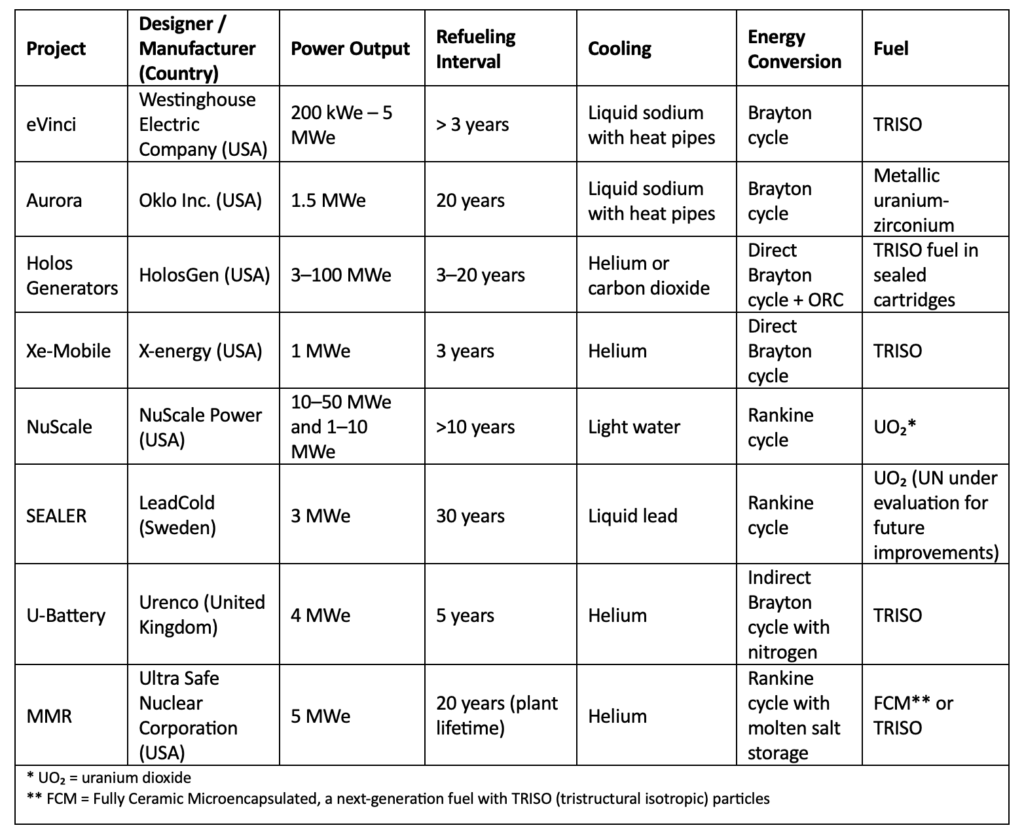
Table 2. Main nuclear micro-reactor projects.
As you can imagine, micro-reactors have some clear advantages, but they also come with challenges in terms of development and some peculiarities when it comes to economics.
The main advantages of micro-reactors are:
1. Low carbon dioxide emissions, which make them a clean energy source, at least in terms of greenhouse gas emissions.
2. Small size, at least compared to NPPs. This allows them to be connected to a microgrid to generate 1 to 20 MWe. Micro-reactors are primarily designed to provide process heat for industrial applications, power remote villages where the electricity grid is not available, or for military installations that require reliable heat and power. Micro-reactors can be an option for quickly restoring electricity in areas damaged by natural disasters (e.g., after a tsunami, hurricane, or earthquake) or for humanitarian aid, e.g., to support hospitals or water supplies for local communities. Thanks to their small size, most components can be assembled in the factory (modularity). This allows for increased production speed, reduced capital costs, and shorter on-site installation times, eliminating some of the typical problems associated with NPPs. In summary, micro-reactors can operate where large reactors cannot. They represent an alternative choice when a clean energy source at moderate cost is needed instead of a large reactor.
3. Simpler plant design. For example, heat pipe technology allows for the development of a compact and simple structure, avoiding reactor cooling pumps and all associated auxiliary systems. The thermal load can be adjusted, allowing for easier autonomous adaptation to the load, and thanks to the high operating temperature, more efficient power conversion can be achieved. Some designs adopt passive safety systems that prevent the risk of overheating or core meltdown. In addition, several micro-reactor models guarantee a long core life, capable of operating without refueling for 10 years or more. This reduces the likelihood of accidents related to fuel handling and movement and, ideally, increases the capacity factor. The combination of all these features makes it possible to design semi-autonomous operations and self-regulating plants within a robust and well-defined safety enclosure. In addition, some micro-reactor models require few on-site workers to support operations. For module maintenance, the possibility of periodic return transport to the factory for inspection and overhaul is taken into account.
4. Ease of on-site installation. Micro-reactors can be connected and generate power in a matter of days, which represents a significant reduction in implementation time compared to NPPs, which typically take years. In addition, they can be easily and quickly removed from the site and replaced with new ones or transported to another site. This feature is useful for reducing installation time and costs, which are significant for NPPs, and makes micro-reactors unique in that they can be used in areas that need to restore electricity in the event of natural disasters or system blackouts. Many micro-reactors are designed to fit into standard ISO containers. This allows for easier transport by rail, truck, ship, and even cargo planes. The ease of transport and installation of micro-reactors (already powered) from the factory to the operating site also raises some issues related to regulations and controls during the transport phase.
There are essentially three main challenges for micro-reactors.
1. Existing nuclear power plants operate with uranium-235 enriched to typically 5%. However, higher enrichment is needed to achieve smaller sizes with a higher power-to-volume ratio and a longer refueling period. This is where HALEU comes in, which could achieve enrichment levels between 5% and 20%. HALEU is also expected to optimize the system for longer core life, increased efficiency, and better fuel utilization. However, it is not currently available on a large scale. Therefore, considerable research and investment is still needed in this area.
2. Using HALEU fuel, which is very rare and valuable, micro-reactors represent an increased risk in terms of safety and proliferation compared to NPPs. In fact, the use of HALEU or higher enrichment fuels makes these plants more attractive to weapons programs, as it reduces the work required to obtain uranium suitable for weapons production. Furthermore, if micro-reactor technology is successful, creating a large-scale market, several units could be distributed around the world and in remote locations. The number of micro-reactors could potentially be much higher than the number of NPPs, making the control of each unit much more complex. It is likely that the control area of a micro-reactor will be much smaller than that of a large nuclear power plant, and security measures may also be lower. Therefore, the risk of potential theft of radioactive material could increase. Finally, the lack of a containment building, as normally required for large nuclear power plants, raises the question of how to deal with the impact of an aircraft or drone.
3. Micro-reactors pose a problem in terms of regulations and design and manufacturing licenses. Micro-reactors should be designed, manufactured, owned, and operated with equipment and services that produce energy and power for specific applications, as explained above. It is therefore essential to pay particular attention to the operating settings of micro-reactors in order to identify the regulatory authority. In particular, new regulations or amendments to existing ones may be necessary for the authorization process. For example, regulations for large nuclear power plants define the presence of workers in the control room. If a micro-reactor is designed to allow remote control and have off-site workers, a change in regulations may be necessary. With regard to the transport of reactor modules powered to and from dispersed sites of use, additional rules will be necessary. In fact, current safety assessment methodologies or acceptance criteria have not been considered to ensure the safety of micro-reactor modules (already powered at the factory) during transport and mobilization/demobilization of modules at very remote sites. There are three main aspects related to licensing. (i) First, the micro-reactor can be built and assembled at the reactor production plant and then shipped to the selected site. In this way, the fuel will have to be shipped to the plant production facility and loaded into the reactor at that facility. It is therefore necessary to design containers for transporting the fuel that are also capable of containing the entire reactor, which, once fueled, will be moved with the fuel on board. (ii) Second, the micro-reactor must be transported from the manufacturing plant to the selected site, and the possibility of returning it to the factory must be taken into account. In these situations, the fuel must remain contained in the reactor module to facilitate movement. (iii) Thirdly, micro-reactors can be designed as temporary or semi-permanent installations. It is therefore necessary to study a versatile, robust, and scalable method for site characterization, environmental assessment, emergency management, etc.
Finally, economic analysis can help us understand whether micro-reactors are competitive. To determine this, we must first understand how much it costs to produce one MWe with a micro-reactor. This is done through analytical accounting, which attributes all direct and indirect, fixed and variable costs related to the micro-reactor to each MWe. The Nuclear Energy Institute (2019) has proposed using the levelized cost of electricity (LCOE) as a comparative element. LCOE is estimated based on certain assumptions. The cost refers to a plant with two 5 MWe micro-reactors, for a total capacity of 10 MWe, and assumes an operating life of 40 years with fuel reloading or replacement of the reactor core every 10 years.
In addition, it is assumed that the micro-reactors are located near existing large power plants, where they would be able to maintain a capacity factor of 95%. In fact, in a microgrid, the micro-reactor may not operate constantly at full power. Site engineering and licensing/permitting costs are included in the capital costs.
Costs are also influenced by factors related to installation conditions (transport accessibility, weather, climate, working conditions) and factors related to micro-reactor design (technology, support plant design). The type of organization that owns the micro-reactors (private or public) and the availability of loan guarantees also influence the cost of capital. However, they are not influenced by the need for additional transmission or distribution infrastructure, as this will also be necessary for the location of other generation technologies.
Finally, there is no basis for comparison. At first glance, the comparison would naturally be made with NPPs. But in reality, these are not the most direct competitors of micro-reactors, but rather the technologies currently used in remote areas. In this context, micro-reactors should be compared mainly with diesel generators of similar size, which currently cover the applications envisaged for micro-reactors. Furthermore, it should be emphasized that, at the expected cost of electricity production, micro-reactors are also competitive with other distributed renewable energy sources, such as rooftop solar panels or all clean energy technologies that power remote communities.
In this context, Table 3 provides a good summary of a comparative economic analysis that justifies the investments being made and hopefully will be made in the future with regard to this innovative technology.
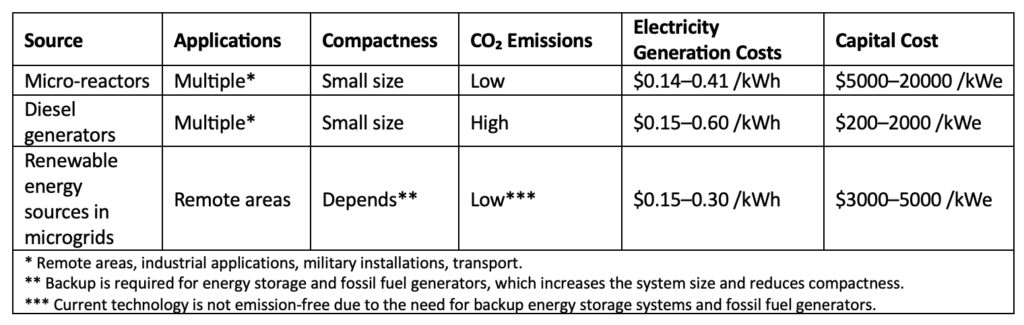
Table 3. Comparison between micro-reactor technologies, diesel generators, and renewable sources in microgrids.
We hope that, in just a few pages, we have highlighted how this investment theme is not only worthy of cabotage allocations right now, but should also be followed and monitored closely. It is not simply an investment in nuclear power that can be implemented by purchasing shares in companies involved in the construction and maintenance of NPPs (which is also a very interesting topic). Rather, it is a niche nuclear power that solves problems that are currently difficult to address with an NPP and, for this very reason, offers the advantage and value of complementarity.
Disclaimer
This post expresses the personal opinion of the Custodia Wealth Management staff who wrote it. It is not investment advice or recommendations, nor is it personalized advice, and should not be considered an invitation to carry out transactions on financial instruments.
